Punjab Assembly triggers controversy with the move to end gender discrimination in Golden Temple to implement teachings of Guru Nanak
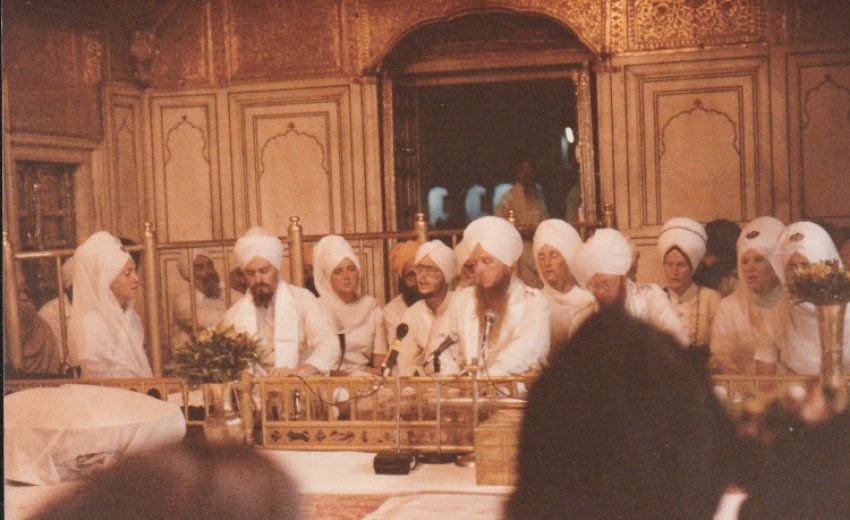
American men and women performing kirtan in Golden Temple.
Jagtar Singh
Chandigarh: The government has no business to do business in
religious domain should be accepted as the basic doctrine. However, this is not
observed in practice. The intervention can’t be selective. If the government
celebrates 550th anniversary of Guru Nanak, there is no reason as to
why it should not initiate steps to put his teachings into practice. Guru Nanak
philosophy is a way of life based upon human equality that includes gender
equality and dignity of human being.
Gender equality is among the basic tenets of teachings of
Guru Nanak and hence of the Sikh doctrine but the practice has been different.
Women are not allowed to perform Kirtan in the Golden Temple that is all male
preserve. Nobody has any rational explanation for not following the teachings
of the Founder of the Faith in this particular context.
The demand to end this gender discrimination that is in violation
of the Sikh tenets has been raised
repeatedly since 1940.
In a historic move, the Punjab Assembly on the second day of
its special session dedicated to 550th anniversary of Guru Nanak on
Thursday adopted unanimous resolution appealing to the Akal Takht Jathedar and
the Shiromani Gurdwara Parbandhak Committee to put the teachings of Guru Nanak
in practice by allowing women to perform kirtan in this most revered shrine of
the community.
The resolution to this effect was moved by panchayats and
rural development minister Tript Rajinder Singh Bajwa and adopted unanimously
after initial reservation expressed by Shiromani Akali Dal that controls the
SGPC.
He had raised the issue on the opening day on Wednesday but
was disallowed as it was perceived to fall under the Rehat- Maryada (code of
conduct) associated with the Sikh way of life. After being certain that it was
not part of any prescribed code, he raised it again today and succeeded in
getting it through.
Here goes the text of the
resolution: Guru Nanak had visualised a society in which there would be no
place for discrimination or distinction on the basis of caste or creed, social status
or gender, a society that is to be based upon the principle of egalitarianism
and committed to welfare of all. It is for this reason that there is no
instance of discrimination in Gurbani or Sikh Gurus history at any level
between man and woman. It is, however, unfortunate that the Sikh women are not
allowed to perform Kirtan in the sanctum sanctorum of the Sri Darbar Sahib,
Amritsar, the most venerated shrine of the Sikhs where there is no space for
discrimination.”
“This session of the Punjab Vidhan
Sabha appeals to the Jathedar of Sri Akal Takht and the Shiromani Gurdwara
Parbandhak Committee to end this discriminatory practice that violates the
essence of Gurbani and allow Sikh women to perform Kirtan in the Sri Darbar
Sahib, Amritsar”.
It may be mentioned that several
women activists had taken it up when Bibi jagir Kaur was appointed the first
women president of this statutory body managing the Sikh shrines in 2000 and
she saw no reason why they should not be allowed. The matter was finally
referred to Akal Takht. This highest Sikh seat for prayer and politics opted
for maintaining status quo rather than take decision in accordance with Guru
Nanak’s doctrine of gender equality.
Such distortions had entered the
Sikh practices when the shrines were taken over by mahants (priestly class)
when the Sikhs were fighting for their survival and escaped to safer places. That
was the period when the rulers had announced bounty on their heads and Sikhs
were hunted. Idols of Hindu deities too were placed in the Golden Temple during
that period. These distortions triggered the gurdwara liberation struggle in
1920.
The controversy over women performing voluntary religious
service at the Golden Temple erupted again in February 2003 when two Sikh women
from Britain were prevented from doing religious service there.
The Assembly had yesterday adopted its first resolution on
taking the message of Guru Nanak to every corner of the world through TV. The resolution
called upon the SGPC to give free signal from live telecast of Gurbani from
Golden Temple that qualify for it and fulfil the laid down conditions.
Presently, the Badal family TV channels monopolise the live
telecast that amounts to commercialisation of the Golden Temple.
This resolution too was adopted unanimously.
While the celebrations are focussing mainly on Kirtan Darbars,
Nagar Kirtans and seminars, these are the only two concrete steps that have
emerged so far to take the teachings of the Guru forward whose 550th
anniversary is being observed.
Baba Nanak practiced what he preached but the Sikhs have
returned to ritualism thyereby betraying the founder of the Faith.
Questions, of course, can be raised about the ruling
Congress entering the religious domain but then the resolutions were adopted
unanimously and moreover, Guru Nanak peached a way of life and an ideal society
based upon equality. He was a revolutionary, not just a religious reformist.
Moreover, these are just appeals to put into practice the teachings of the Guru
and propagate his ideas.
Comments
Post a Comment