Sanction to prosecute Kanhaiya: Kejriwal positions AAP as second line of Sangh Parivar - Inquilab Zindabad
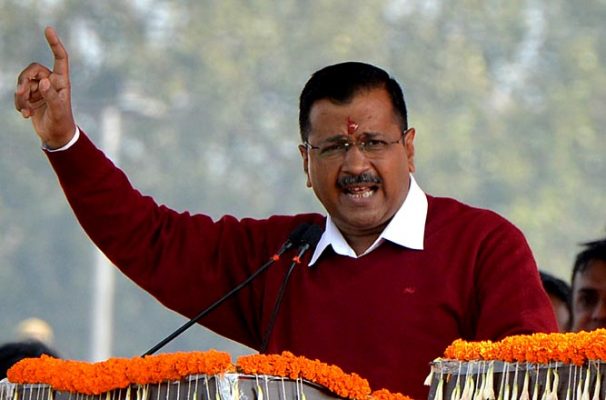
The signals were already there.
The decision of the Arvind Kejriwal’s Aam Aadmi Party government
to accord sanction to prosecute Left leader and former JNU president Kanhaiya
Kumar under the colonial sedition charge has only confirmed it.
He has positioned his party not just at Right of the Centre
but also as second line of the Sangh Parivar.
This positioning fits perfectly in the framework of Kejriwal
having emerged as the leader from Anna Hazare led movement against corruption
subtly designed by the Sangh sympathetic Delhi based Vivekananda Institute.
The controversial law of sedition is back into focus as the
dissenters are being charged under this legislation enacted by the British
rulers. There is no such law in UK, the country that framed it to rule over
India. The law is a legacy of slavery of India. This law suits the rulers and
reinforces the perception that the Indians continue to be dictated by the same
mentality.
Kejriwal did not intervene or even react when the goons
entered the Jawaharlal Nehru University or the police attacked Jamia Milia
University library. The list is long.
That he was catering the fundamentalist Hindu and
anti-Muslim sensibility became evident during the Delhi Assembly elections in
which he received massive mandate. Despite the fact that he avoided Shaheen
Bagh, the symbol of protest against the discriminatory CAA, the Muslims voted for him to defeat the
blatantly divisive BJP. However, in the process, the country has seen the
emergence of another, what can be termed as, the Hindu leader.
The latest example is that of riots in Delhi.
He refused to intervene.
The issue here is not that of the Delhi police being under
the Union home ministry.
The chief minister has a moral authority and that authority
balances the absence of police powers. He could have rushed to the spot rather
than just tweeting. He is equally to be blamed for the situation in Delhi. At least
this could have stopped the police in the initial stage from being complicit with
the saffron rioters of which there is now ample proof.
The issue of Kanhaiya Kumar is part of the same narrative.
AAP spokesperson and MLA Raghav Chadha was heard defending this action saying
the AAP government had always provided sanction to every case. This case,
however, is different. This case is part of the broader Sangh design.
It is apparent that Kejriwal is eyeing the space that has
been vacated by the Congress in the country by behaving as a soft Hindu party.
The Congress for years also functioned in this very framework and was known as
the Hindu Congress till 1947. Congress had used communalism as a tool while for
the BJP, it is a policy. The Congress fell into the trap in Delhi by supporting
AAP to stop the BJP onslaught. In the process, it is the Congress that stands
decimated in the Capital.
This positioning, however, would become a hurdle for the
party in Punjab where AAP has sizeable presence. The massive mandate in Delhi
had given the hope of revival of the party to its leaders in Punjab. Kejriwal yesterday
appointed former MLA Jarnail Singh as incharge of Punjab. However, it would be
difficult for him as a leader of the Hindu party to re-occupy the space that
the party has lost due to factionalism.
AAP had been projecting itself as a non-ideological party
wedded only to governance.
Not anymore. AAP has taken ideological position by
sanctioning prosecution of Kanhaiya Kumar.
Inquilab Zindabad.
Very much true
ReplyDelete